


Tax Day Countdown and Important Tax Deadlines!
Learn moreOptimize Your Q4: Tax Planning & Savings Checklist
Don t Wait Until Tax Season Your Q4 Tax Planning Checklist
Q4 is the moment to turn tax planning from a rushed filing-season chore into a calm, practical review of your income, deductions, credits, and cash flow. This guide gives you a clear q4 tax planning checklist you can use before December 31, with ideas for individuals, families, freelancers, and small business owners. Think of it as the working version of “Don't Wait Until Tax Season: Your Q4 Tax Planning Checklist”—helpful, organized, and designed to start better conversations with your tax professional.
This article is general education, not personalized tax advice. Tax rules change, and your filing status, income, state taxes, investment activity, and business structure can all change the right move.
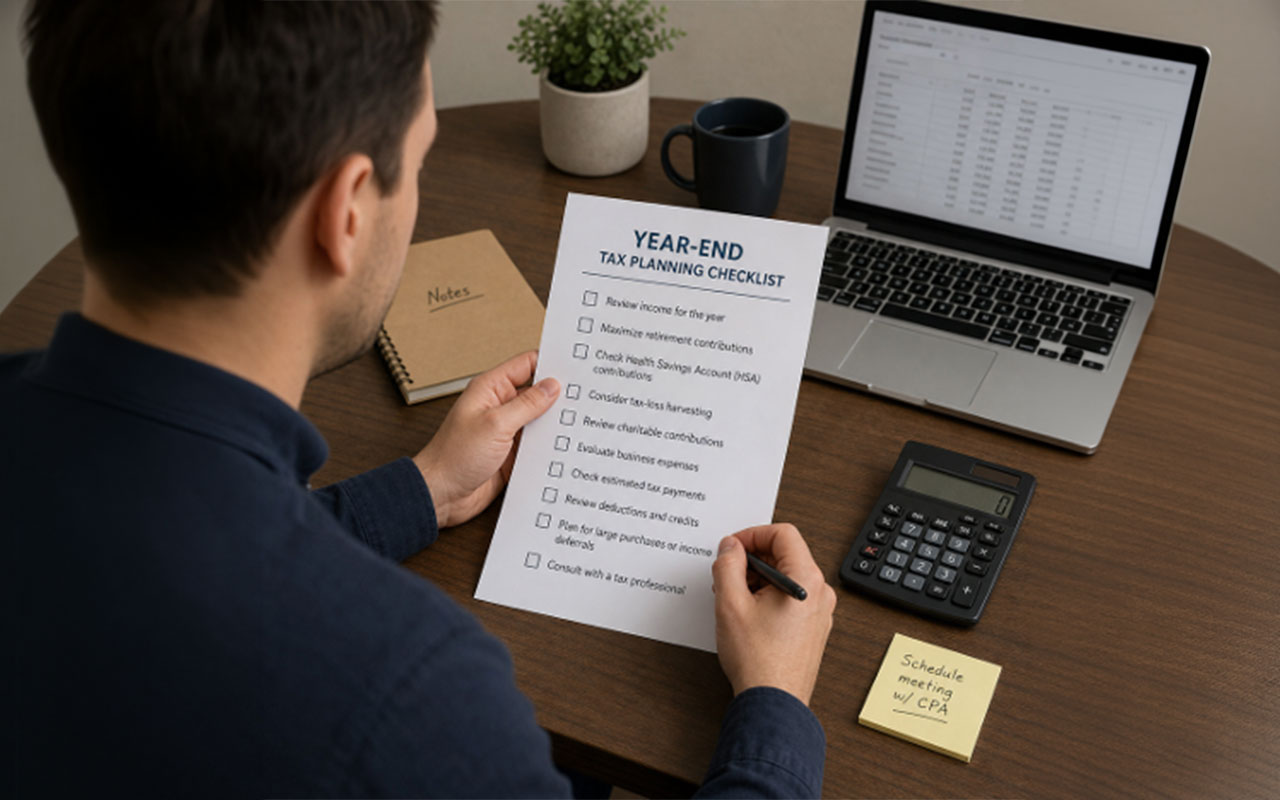
Quick outline for your Q4 tax review
Use this outline to move from the big picture to the details. You do not need to solve everything in one sitting, but you should identify the decisions that must happen before year-end.
Review income and withholding: Estimate your total income, taxes already paid, and whether you may owe or receive a refund.
Update your tax deduction checklist: Gather deductible expense records while you still have time to act.
Check retirement and health account contributions: Confirm what can still be increased through payroll or account contributions.
Plan charitable giving: Make donations before the deadline and keep proper records.
Review business expenses: Capture receipts, mileage, invoices, asset purchases, and contractor payments.
Discuss timing moves: Decide whether to accelerate income, delay expenses, harvest investment losses, or make other timing choices.
What should you do before December 31?
Before December 31, focus on tax moves that are tied to the calendar year: withholding changes, many charitable gifts, business purchases, retirement contributions made through payroll, and documentation for deductions. The goal is not to “find loopholes”; it is to make sure the year you are about to close reflects the deductions, credits, and payments you are legally entitled to claim.
Start with a rough projection. Add wages, freelance income, interest, dividends, investment sales, rental income, retirement distributions, and any large one-time payments. Then compare that estimate with your withholding and estimated payments. The IRS Tax Withholding Estimator can help employees and pension recipients review whether they are withholding too little or too much and can generate a Form W-4 or Form W-4P if changes are needed. (irs.gov)
This step matters because Q4 is still early enough to correct course. If you discover you are underpaid, you may be able to increase withholding, make an estimated payment, or plan for cash needs before filing season. For 2026 estimated taxes, the fourth federal estimated payment is due January 15, 2027, for calendar-year individual taxpayers. (irs.gov)
Build your year-end tax deduction checklist
A useful tax deduction checklist is not just a pile of receipts. It should connect each possible deduction to proof, timing, and eligibility. In Q4, create folders for income, deductions, credits, business expenses, charitable giving, medical costs, education, home ownership, and investment activity.
Standard deduction vs. itemizing
For tax year 2026, the standard deduction is $16,100 for single filers and married people filing separately, $32,200 for married couples filing jointly, and $24,150 for heads of household. Those amounts are important because itemized deductions only help when they exceed the standard deduction for your filing status. (content.govdelivery.com)
If you are close to itemizing, Q4 planning can be especially valuable. Mortgage interest, state and local taxes, charitable gifts, and certain medical expenses may affect the decision. You may not know the final answer until your return is prepared, but you can gather the records now and ask whether bunching deductions into one year makes sense.
Charitable giving records
If you make charitable contributions, do not wait until April to look for proof. The IRS generally requires a bank record or written communication from the qualified organization for cash contributions, showing the organization name, date, and amount. For donations of $250 or more, written acknowledgment rules become more specific, and noncash contribution rules vary by amount. (irs.gov)
Good Q4 practice is simple: save receipts, note donation dates, keep descriptions of noncash items, and avoid estimating values without support. If you donate appreciated assets, a vehicle, or high-value property, talk with a tax professional before transferring it.
Business and self-employment expenses
Freelancers, contractors, and business owners should use Q4 to clean up bookkeeping. Reconcile accounts, categorize expenses, document business mileage, review unpaid invoices, and confirm which expenses were actually paid or incurred under your accounting method.
A practical business checklist includes:
Bank and credit card statements
Receipts for software, supplies, equipment, dues, and subscriptions
Home office details, if applicable
Mileage logs and business travel records
Contractor payments and Forms W-9
Invoices sent and payments received
Asset purchase dates and costs
The best tax savings strategies usually start with clean records. When your books are current, your tax professional can help you evaluate timing decisions instead of spending the entire meeting reconstructing the year.
Retirement and health account moves can still matter
Q4 is a good time to review retirement contributions, especially if your income changed or you have not contributed consistently. For 2026, the employee contribution limit for 401(k), 403(b), most 457 plans, and the federal Thrift Savings Plan is $24,500. The IRA contribution limit is $7,500, with an additional $1,100 catch-up amount for eligible individuals age 50 and older. (irs.gov)
If you contribute through payroll, December deadlines can arrive quickly because changes may need time to process. If you are self-employed, ask about SEP IRA, solo 401(k), SIMPLE IRA, or other options before year-end, because setup and contribution deadlines vary.
Health Savings Accounts can also be part of Q4 planning if you are eligible. For 2026, the HSA contribution limit is $4,400 for self-only high-deductible health plan coverage and $8,750 for family coverage. The 2026 high-deductible health plan minimum deductible is $1,700 for self-only coverage and $3,400 for family coverage, with out-of-pocket maximums of $8,500 and $17,000 respectively. (irs.gov)
Tax savings strategies to discuss before year-end
The right tax savings strategies depend on your facts, but Q4 gives you a chance to ask better questions. Instead of asking, “How do I lower taxes?” ask, “Which actions still need to happen before December 31, and which can wait until filing season?”
Consider discussing these planning ideas:
Adjust withholding or estimates. If your income rose, your side business grew, or investment gains were larger than expected, update your payment plan.
Time income and expenses carefully. Some taxpayers may benefit from accelerating deductible expenses or delaying income, while others may prefer the opposite.
Harvest investment losses thoughtfully. Selling investments at a loss may offset gains, but wash sale rules and portfolio goals matter.
Maximize eligible retirement contributions. Extra contributions may reduce taxable income or build tax-advantaged savings, depending on the account type.
Review credits before making purchases. Credits often have strict eligibility, documentation, and placed-in-service rules.
Energy-related credits are a good example of why you should verify details before acting. Some credits are nonrefundable, meaning they can reduce tax liability but may not create a refund beyond what you owe, and the IRS directs taxpayers to use Form 5695 for certain residential energy credits. (irs.gov)
Clean vehicle rules have also changed. The IRS states that new and previously owned clean vehicle credits generally apply only to vehicles acquired on or before September 30, 2025, while certain home refueling or recharging property placed in service before July 1, 2026, may qualify for a separate credit. (irs.gov)
Documents to gather before tax season starts
The more organized you are in Q4, the less stressful tax season becomes. Create one digital folder and one physical folder if you still receive paper documents. Name files clearly, such as “2026 charitable receipts,” “2026 estimated tax payments,” or “2026 business mileage.”
Use this final collection checklist:
Last year’s tax return
Final pay stubs for you and your spouse, if applicable
Estimated tax payment confirmations
Brokerage statements and realized gain/loss reports
Mortgage interest and property tax records
Charitable contribution receipts
Medical, dental, and insurance expense records
Childcare and education payment records
Retirement and HSA contribution confirmations
Business income, expense, mileage, and asset records
Notices from the IRS or state tax agencies
Do not worry if every official tax form has not arrived yet. Q4 planning is about estimating, organizing, and making time-sensitive decisions. Filing comes later; planning happens now.
The takeaway
A strong Q4 tax planning checklist gives you control before the year closes. Review your income, check withholding, organize deductions, confirm contribution opportunities, and ask about strategies while there is still time to act. Tax season is much easier when you are not using it to fix decisions that could have been handled months earlier.