


Tax Day Countdown and Important Tax Deadlines!
Learn more1099 Reporting Changes 2026: A Business Guide
Who Gets a 1099 and Who Doesn’t in 2026? A Practical Guide for Businesses and Agencies
The rules for 1099 reporting are changing again in 2026, and this time the shift is big enough to impact almost every business and agency that works with independent contractors. Flat Top Accounting Solutions created this guide to help you understand who gets a 1099, who does not, and what you should be doing now so January is a smooth finish to your year, not a mad scramble.

Stay Ahead of 2026 1099 Changes
Clarity on who gets a 1099 and how to prepare your year-end checklist
The Big 2026 Shift: 1099-NEC Threshold Rises to $2,000
For years, the magic number for issuing Form 1099-NEC or 1099-MISC was $600. Starting with payments made on or after January 1, 2026, that threshold jumps to $2,000 for most nonemployee compensation and many miscellaneous payments, thanks to the One Big Beautiful Bill Act (OBBBA) enacted in 2025 (IRS 2026-19 IRB). Practically, this means:
If you pay an independent contractor less than $2,000 in 2026, you generally do not need to issue Form 1099-NEC (unless backup withholding applies).
Once your total payments to that contractor reach $2,000 or more for the year, 1099 reporting usually kicks in.
Beginning in 2027, this threshold will be indexed for inflation, so it can adjust over time. But keep in mind: all income is still taxable to the recipient, even if no 1099 is issued. The threshold only determines whether you, as the payer, must report the payment on an information return, not whether the contractor has to report the income (IRS, Am I Required to File a Form 1099).
💡 Pro Tip: Think of the new $2,000 threshold as a reporting rule, not a taxability rule. Your vendors still owe tax on their income, even when no 1099 is required.
Who Generally Needs a 1099 in 2026?
As you plan your 1099 reporting for 2026, focus first on who typically should receive a form when the $2,000 threshold is met. At Flat Top Accounting Solutions, we encourage clients to think in terms of type of payee and type of payment.
Independent Contractors and Freelancers
If you hire an individual or business to perform services for your company and they are not your employee, they are usually treated as an independent contractor. In 2026, if you pay them $2,000 or more in nonemployee compensation during the year, you will generally need to issue a Form 1099-NEC for those payments. This includes:
Consultants, coaches, and trainers engaged by your business or agency
Freelance designers, marketers, copywriters, and virtual assistants
Contract IT support, developers, and other project-based professionals
Real-World Example: A marketing agency in Colorado hired a freelance video editor for several projects throughout 2026. Each invoice was only $400–$600, so the owner initially assumed no 1099 was needed. When Flat Top Accounting Solutions reviewed their books in December, we saw total payments of $2,400 by ACH. Because the $2,000 threshold was crossed, the agency did need to issue a 1099-NEC. Catching this early prevented a missed filing and a potential penalty.
Sole Proprietors and Individuals Using a DBA
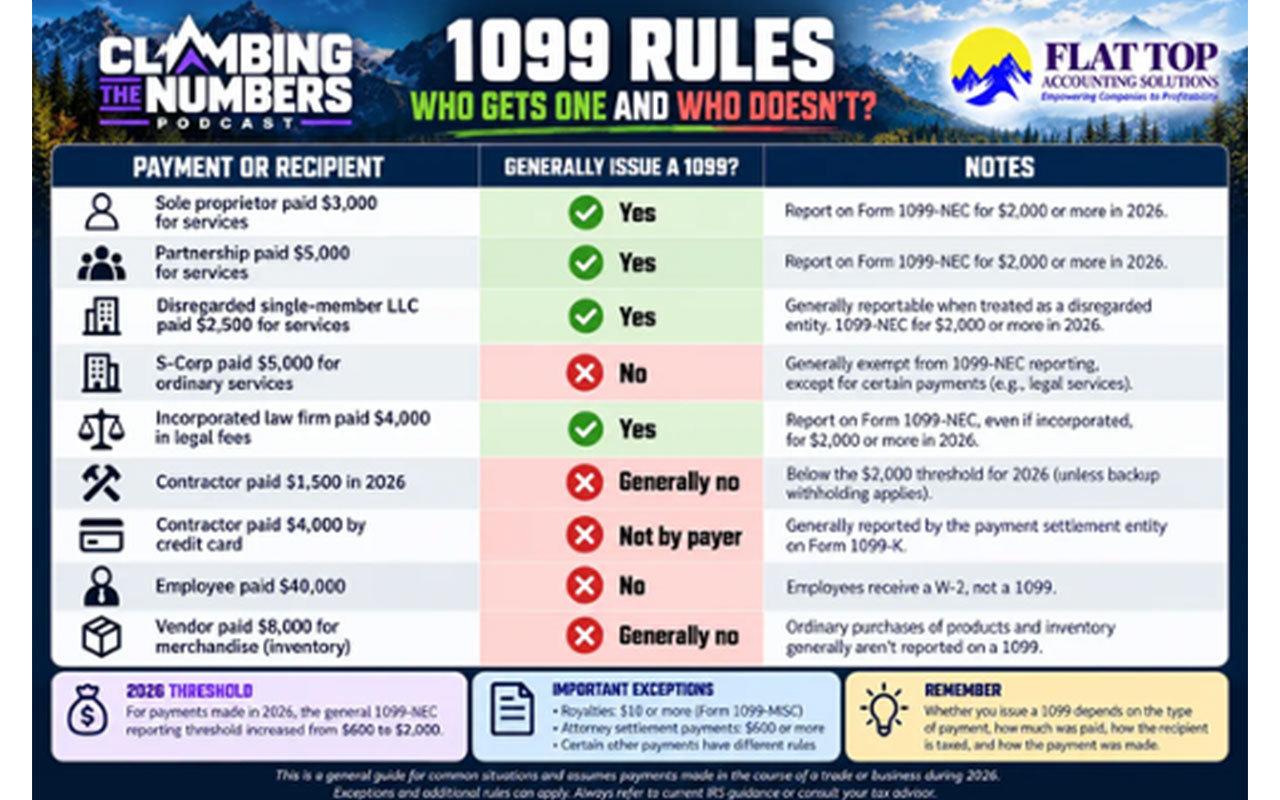
A sole proprietor may operate under their personal name or a “doing business as” (DBA) name. Either way, if you pay them $2,000 or more for business services in 2026, they generally belong on your 1099-NEC list. The same rule applies whether you write checks to “Jane Smith” or “Smith Creative Studio.”
Partnerships and Most Multi-Member LLCs
Partnerships, including most LLCs taxed as partnerships, typically do receive 1099s when they provide services and your payments reach the $2,000 threshold. Many agencies assume “LLC” means no 1099 is required, but what matters is how the entity is taxed, not just what’s printed on the business card.
Case Study: A regional construction company in Texas paid over $45,000 to “High Point Electrical LLC” for subcontracting work. Because the vendor name included “LLC,” the office manager assumed they were a corporation and skipped the 1099. During a review, Flat Top Accounting Solutions requested the W-9 and discovered the LLC was taxed as a partnership, meaning 1099 reporting was required. We helped the client correct prior-year filings and avoided repeat exposure going forward.
Single-Member LLCs (Disregarded Entities)
A single-member LLC that has not elected to be taxed as a corporation is usually a disregarded entity for federal tax purposes. In practice, that means you treat it like a sole proprietorship. If you pay a single-member LLC $2,000 or more for services in 2026, you generally must issue a 1099-NEC using the name and taxpayer identification number (TIN) reported on their W-9.
Attorneys and Law Firms
Legal fees are a major exception to the usual corporation rule. You must generally report legal fees of $2,000 or more paid in the course of your trade or business, even when the law firm is a C corporation or S corporation. In addition, some settlement-related payments still use a $600 threshold, so it is crucial to review the IRS instructions or work with your accountant when settlements or judgment payments are involved.
Landlords and Business Rent Payments
If your business pays commercial rent of $2,000 or more in 2026 to a landlord who is not exempt, those payments are generally reported on Form 1099-MISC. This often applies when you rent office, warehouse, or retail space directly from an individual or partnership. Again, the landlord’s tax classification matters, so their W-9 is essential for proper 1099 reporting.
Real-World Example: A therapy practice in Ohio rented office space from an individual landlord for $2,200 per month. The landlord insisted that “my CPA handles everything” and never returned a W-9. Flat Top Accounting Solutions advised the practice to document their W-9 requests, begin backup withholding if necessary, and continue reporting rent on Form 1099-MISC. That documentation proved valuable when the IRS questioned missing TIN information.
Medical and Health Care Providers
Certain payments of $2,000 or more to medical and health care providers are reportable on Form 1099-MISC, even when the provider is incorporated. This can apply to employer-sponsored wellness programs, on-site clinics, or other health-related services paid in the course of your trade or business. If your business or agency makes these types of payments, they deserve special review each year.

Who Generally Does Not Need a 1099-NEC?
The flip side of 1099 reporting is knowing when a form is not required. Misunderstanding this can lead to unnecessary paperwork or, worse, missing a required form because you assumed the wrong rule.
C Corporations and S Corporations (With Exceptions)
In general, payments to C corporations and S corporations are exempt from 1099-NEC reporting. This is why the W-9 is so important: it tells you whether the payee is taxed as a corporation. However, there are key exceptions, including:
Attorney fees (as noted above)
Certain medical and health care payments
Employees (W-2, Not 1099)
True employees never receive a 1099-NEC for their wages. Instead, they receive a Form W-2. Misclassifying employees as contractors is a serious compliance risk and can trigger back payroll taxes, penalties, and interest. Your year-end review should always include a quick check that workers are correctly classified as either employees (W-2) or independent contractors (1099).
Case Study: A growing e-commerce brand treated its warehouse pickers as “independent contractors” and issued 1099s instead of W-2s. After a state labor audit, the workers were reclassified as employees. Flat Top Accounting Solutions helped the owner calculate back payroll taxes and implement proper W-2 payroll going forward—an expensive reminder that classification errors are far costlier than good setup.
Vendors Selling Only Merchandise or Inventory
Ordinary purchases of products, inventory, or goods generally do not require a 1099-NEC. For example, your office supply vendor or the manufacturer that sells you finished products typically will not receive a 1099 for those purchases. The focus is on services, not goods, although some mixed contracts may require a closer look.
Contractors Paid Less Than $2,000 in 2026
With the new threshold, if you pay a contractor less than $2,000 in total during 2026, you generally do not need to issue a 1099-NEC, unless backup withholding applies because they failed to provide a valid TIN. Even when no 1099 is required, Flat Top Accounting Solutions still recommends collecting a W-9 so you are covered if that contractor’s total payments increase later in the year.
Personal, Non-Business Payments
1099 reporting applies to payments you make in the course of your trade or business. If you personally hire someone to paint your home or mow your lawn, those are personal expenses and generally do not require a 1099, even if the amounts are large. The same contractor, hired by your company to paint your office, might require a 1099 if the amount and other conditions are met.
Payments Made by Credit Card or Third-Party Networks
Payments made by credit card or through certain third-party payment networks (like qualifying PayPal or similar platforms) are generally reported by the payment settlement entity on Form 1099-K, not by you on Form 1099-NEC. That means:
You usually do not issue a 1099-NEC for amounts you paid by credit card, even if they exceed $2,000.
You do need to track and report payments made by check, ACH, or cash separately.
Important Exceptions and “Gotchas” to Watch
Even with the higher threshold, several categories still have lower dollar limits or special rules. These often trip up otherwise diligent businesses and agencies.
Royalties: Many royalty payments remain reportable at $10 or more on Form 1099-MISC, even after the 2026 changes (IRS Form 1099-MISC instructions).
Certain attorney settlement payments: Some settlement-related payments still use a $600 threshold, and may be reported on either 1099-NEC or 1099-MISC depending on the nature of the payment and who receives it.
Payment method matters: You must review check, ACH, cash, credit card, and third-party network payments separately because some are reported on 1099-NEC/1099-MISC and others on 1099-K.
LLC classification: An “LLC” in the name does not automatically exempt a vendor. Their tax classification on the W-9—sole proprietor, partnership, C corporation, or S corporation—is what drives your 1099 reporting obligation.
📌 Key Takeaway: Many 1099 “gotchas” come from assumptions—assuming an LLC is a corporation, assuming card payments need a 1099-NEC, or assuming settlements follow the $2,000 rule. When in doubt, check the IRS instructions or reach out to Flat Top Accounting Solutions.
Real-World Scenarios: Applying the 2026 1099 Rules
To make these rules more concrete, let’s walk through the discussion questions we often hear from clients at Flat Top Accounting Solutions.
“If I pay a plumber $3,000 to repair my business property, do I need to issue a 1099?”
In 2026, yes, probably—if the plumber is not a corporation and you paid by check, ACH, or cash. You paid more than $2,000 for services in the course of your trade or business, so that payment generally belongs on Form 1099-NEC, assuming the plumber is a sole proprietor, partnership, or disregarded single-member LLC.
“What if that plumber operates as an S-Corp?”
If the plumber’s W-9 shows they are taxed as an S corporation, then you generally do not issue a 1099-NEC for the $3,000 payment. This is a prime example of why W-9 collection is so important: the same dollar amount can be reportable or not, depending on how the vendor is taxed.
“What if I paid the plumber using a credit card?”
When you pay via credit card, the payment processor generally becomes responsible for reporting those payments on Form 1099-K. In that case, you typically do not issue a 1099-NEC for the same payment, even if the plumber is not incorporated and even if the total exceeds $2,000.
“Does having an LLC automatically exempt someone from receiving a 1099?”
No. “LLC” is a legal label, not a tax classification. A single-member LLC is often taxed as a sole proprietorship (and thus generally reportable), while another LLC might elect to be taxed as an S corporation (often not reportable). The W-9 reveals how the entity is taxed, which is what you use to determine your 1099 reporting obligations. Never rely on the name alone.
📌 Key Takeaway: Whether someone receives a 1099 depends on the type of payment, how much was paid, how they are taxed, and how the payment was made.
Preparing Your 1099s Now: Practical Steps for 2026 and Beyond
January deadlines come fast. The easiest way to simplify 1099 reporting—and to adapt smoothly to the new 2026 threshold—is to build good habits throughout the year. Here’s how Flat Top Accounting Solutions guides clients through 1099 preparation.
1. Collect W-9s Before You Pay Contractors
Make W-9 collection part of your onboarding process for every new vendor who might provide services. This form tells you:
The correct legal name and address to use on a 1099
Their taxpayer identification number (TIN)
Their tax classification (individual/sole proprietor, partnership, C corp, S corp, etc.)
Conversation Starter: “Why is it so much easier to collect a W-9 before you pay someone than three months afterward?” Because once a vendor has been paid, your leverage drops and your follow-up workload increases. Build W-9 Collection into your standard workflow and avoid the last-minute chase.
2. Review Vendors and Payments in QuickBooks (or Your Accounting System)
Run a vendor summary report and identify anyone who:
Provided services to your business, and
Was paid close to or above $2,000 in 2026 by check, ACH, or cash.
Don’t assume your software is flagging every reportable vendor correctly. Accounting systems are powerful tools, but they only work as well as the data and settings you provide. A quick human review, especially in a year with Tax Changes 2026, is essential.
Real-World Example: A design studio in Georgia relied solely on its accounting software’s “1099 vendor” checkbox and missed several reportable contractors who had been set up incorrectly. When Flat Top Accounting Solutions ran a manual vendor summary and filtered by payment type, we identified five additional contractors over the threshold. Correcting those filings helped the owner avoid IRS notices the following spring.
3. Verify Names, Addresses, and TINs—and Identify Missing W-9s
Confirm that your vendor records match their W-9s. Look for:
Incomplete or outdated addresses
Missing or invalid taxpayer identification numbers
Vendors with no W-9 on file at all
Identifying gaps now gives you time to request updated W-9s and avoid backup withholding problems or rejected 1099s later.
4. Separate Payments by Method: Check, ACH, Credit Card, and Networks
For accurate 1099 reporting, you need to distinguish between:
Check/ACH/cash payments (generally your responsibility on 1099-NEC or 1099-MISC)
Credit card and qualifying third-party network payments (generally reported by the processor on 1099-K)
Many accounting systems can filter by payment method. Use that feature to avoid double-reporting or missing required forms.
W-2s and Year-End Payroll: Avoiding Common January Mistakes
1099 Reporting is only half the year-end story. Your W-2s and payroll need equal attention. At Flat Top Accounting Solutions, we often see the same preventable issues every January—and they can all be fixed with a little preparation.
Verify employee information: Names, addresses, and Social Security numbers should match what’s on file with the Social Security Administration. Small typos can create big headaches.
Review bonuses and taxable fringe benefits: Year-end bonuses, gift cards, personal use of company vehicles, and certain reimbursements may need to be included in taxable wages before the final payroll runs.
Reconcile payroll reports with your books: Your payroll provider’s year-to-date totals should align with your general ledger. If the numbers do not match, find out why before W-2s go out.
Review payroll tax liabilities: Confirm that all federal, state, and local payroll taxes have been filed and paid, and that balances on your books match agency notices.
Discussion Question: “What are some of the most common payroll mistakes we see when January rolls around?” In our experience: missed bonuses, unreported fringe benefits, incorrect employee addresses, and mismatched payroll vs. bookkeeping totals top the list.
S-Corp Owner Payroll Considerations: Distributions vs. W-2 Wages
If your business is taxed as an S corporation, owner payroll needs special attention. The IRS expects shareholder-employees who are actively working in the business to receive reasonable compensation as W-2 wages, not just distributions. This is a key area where Flat Top Accounting Solutions helps owners protect themselves and stay compliant.
Review reasonable compensation: Evaluate whether the S-corp owner’s W-2 wages reflect the value of the services they provide, considering industry standards, hours worked, and responsibilities.
Remember: distributions are not a substitute for payroll. Distributions can be a tax-efficient way to take profits, but only after a reasonable salary has been paid and payroll taxes have been handled correctly.
Verify shareholder health insurance reporting: Certain health insurance premiums for more-than-2% S-corp shareholders must be included in their W-2 as taxable wages, even if the company pays the premiums directly.
Coordinate owner bonuses and final payroll: If you plan year-end bonuses for S-corp owners, coordinate with your accountant and payroll provider before the last payroll of the year so everything is captured correctly.
Discussion Question: “What happens when an S-Corp owner has been taking distributions all year but hasn't run any payroll?” In many cases, the IRS can reclassify distributions as wages, assess back payroll taxes, penalties, and interest, and scrutinize the business more closely going forward.
Closing: Your Year-End Checklist for 1099s, W-2s, and S-Corp Payroll
January should be about starting the new year strong, not untangling last year’s paperwork. A focused year-end checklist can help your business or agency stay ahead of 1099 Reporting, payroll, and S-corp compliance. Here are five action items Flat Top Accounting Solutions recommends:
1. Identify vendors who may require a 1099. Use your accounting system to flag service providers, landlords, attorneys, and medical providers paid close to or above the new $2,000 threshold in 2026, and separate out payments made by credit card or third-party networks.
2. Collect missing W-9s. Reach out now to any vendor without a current W-9 on file. This is the foundation of accurate 1099 Reporting and helps you avoid backup withholding and IRS notices later.
3. Review employee information and payroll records. Confirm that your payroll data, including bonuses and taxable benefits, is complete and reconciled with your bookkeeping before W-2s are issued.
4. Verify S-Corp owner compensation and benefits. Make sure shareholder-employees have received reasonable W-2 wages and that any required health insurance reporting is included in payroll before year-end.
5. Coordinate year-end reporting with your accountant. Don’t wait until January to ask questions about Independent Contractors, Tax Changes 2026, W-9 Collection, or S-corp Payroll. A brief planning conversation now can save hours of cleanup later.
As we remind our clients across the United States: “January shouldn’t be the first time you start thinking about your 1099s and W-2s. A little preparation now can save a lot of headaches later.” If you’d like a partner to help you implement this year-end checklist, interpret the 2026 1099 thresholds, or streamline your accounting processes, Flat Top Accounting Solutions is here to serve as your dedicated accounting department.